Prototype vsProduction Tooling
Soft tool or hardened steel? The answer is a curve, not a coin flip. MUD, bridge, and SPI tooling compared on life, tolerance, lead time, and where volume and cost cross over.
Engineer reviewed quote
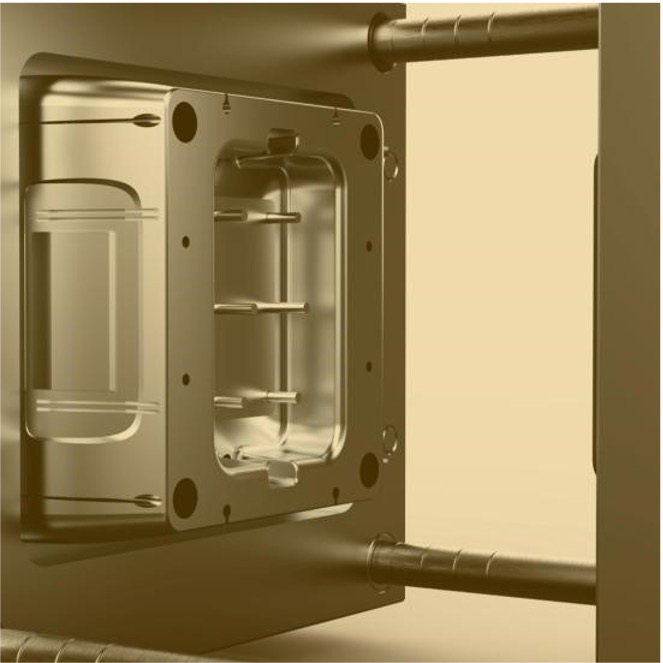
The three tiers
Injection tooling is not one thing. It scales with your program, from a cheap soft tool for validation to hardened steel built to run for years. There are three tiers, and most programs pass through more than one.
Prototype (MUD)
Aluminum or soft steel in modular unit die frames. Ready in as fast as 10 days, cheap to modify, molded in the real production resin. Limited tool actions and life.
Bridge
Production-grade features and specialty actions at a 3 to 4 week lead time. Gets real parts to market while the production tool is still on the schedule.
Production (SPI)
Hardened steel, multi-cavity, full automation. Tightest tolerances and lowest per-part cost at volume, with a million-plus shot life.
Side by side
| Prototype (MUD) | Bridge | Production (SPI) | |
|---|---|---|---|
| Design stage | Needs Validation | Validated / Market Launch | Full Production |
| Volume | 100–5,000 | 5,000–20,000 | 20,000–1,000,000+ |
| Lead time | 10–15 days | 3–4 weeks | 4–6 weeks |
| Tolerance | ±0.005"–±0.010" | ±0.003"–±0.008" | ±0.002"–±0.005" |
| Benefits | Short lead time, easy revisions, real molded parts | Full tool actions, family tooling, better per-part pricing | Multi-cavity tools, lowest per-part cost at volume |
| Tradeoffs | Limited tool action, limited tool life | Tool life is limited without maintenance | Longer lead time and higher upfront tooling cost |
SPI mold classes
The Plastics Industry Association classifies molds by expected cycle life. The class you need follows your volume forecast: do not buy a Class 101 tool for a 10,000-part program, and do not run a Class 105 tool for a million parts.
| Class | Tier | Cycle life |
|---|---|---|
| Class 101 | Production | 1,000,000+ |
| Class 102 | Production | Up to 1,000,000 |
| Class 103 | Production | Up to 500,000 |
| Class 104 | Bridge | Under 100,000 |
| Class 105 | Prototype | Under 500 |
When to switch
The economics are a crossover. A soft tool is cheap up front but costs more per part and wears out. A hardened tool costs more to build but drives the per-part price down and runs for years. Where they cross depends on your annual volume and how long the program lives.
As a rough guide: validate and run small on prototype tooling, move to bridge once the design is proven and parts need to ship, and commit to production tooling when volume is past roughly 5,000 to 20,000 a year or you need the tightest tolerances and full automation.
The part that trips programs up is the handoff. If your prototype vendor cannot build the production tool, you re-source, re-do DFM, and re-validate. Glide keeps one team across all three tiers, so the production tool builds on what the prototype learned. That is the core of our comparison to rapid-prototype vendors.
Common questions.
Prototype tooling is aluminum or soft steel in modular MUD frames: fast, cheap, and good for validation, with limited tool life. Production tooling is hardened steel (P20, H13, 420SS) built to SPI standards, with full tool actions, tighter tolerances, and a shot life from 100,000 into the millions. Between them sits bridge tooling, which offers production-grade features at a shorter lead time.
The Plastics Industry Association defines mold classes by expected life. Class 101 is a million-plus cycles, Class 102 up to a million, Class 103 up to 500,000, Class 104 under 100,000 for bridge work, and Class 105 under 500 for prototypes. The class you need follows your volume forecast.
Move when the design is locked and the volume justifies the tooling investment. Prototype tools make sense for validation and runs up to a few thousand parts. Once you are past roughly 5,000 to 20,000 parts a year, or you need tighter tolerances and full automation, hardened production tooling pays for itself in lower per-part cost.
Prototype MUD tooling can be ready in as fast as 10 days. Bridge tooling runs 3 to 4 weeks. Production tooling is a 4 to 6 week build, longer for large multi-cavity tools. Once any tool is approved, parts typically ship within a week or two.
Not at Glide. The same engineering team carries the part from prototype through production, so the production tool is designed as a continuation of what the prototype taught us, not a fresh start with a new vendor. That is the difference from a rapid-prototype-only shop; see our comparison for the details.
Bridge tooling covers the gap between validation and full production. You get production-grade tool features, specialty actions, and better per-part pricing at a shorter lead time than a full production tool, so real parts ship while the production tool is still being built.
Related
Not sure which tier you need?
Send the part and your volume forecast. An engineer recommends the tooling tier and quotes it. See the full injection molding process.
Get a Quote